
Introduction
Borewell water is a common source of drinking water in many Indian homes, apartments and residential areas.
Unlike treated municipal water, groundwater quality can vary significantly depending on the location, soil, rocks and depth of the borewell.
Some borewell water may contain high levels of dissolved salts, hardness, iron, fluoride or nitrate. In certain areas, microbial contamination may also be a concern.
This is why choosing the right water purifier for borewell water is important.
But should you buy an RO purifier, a UV purifier or an RO+UV combination?
In this guide, we will explain common borewell water problems, suitable purification technologies and the important features to check before purchasing a water purifier.
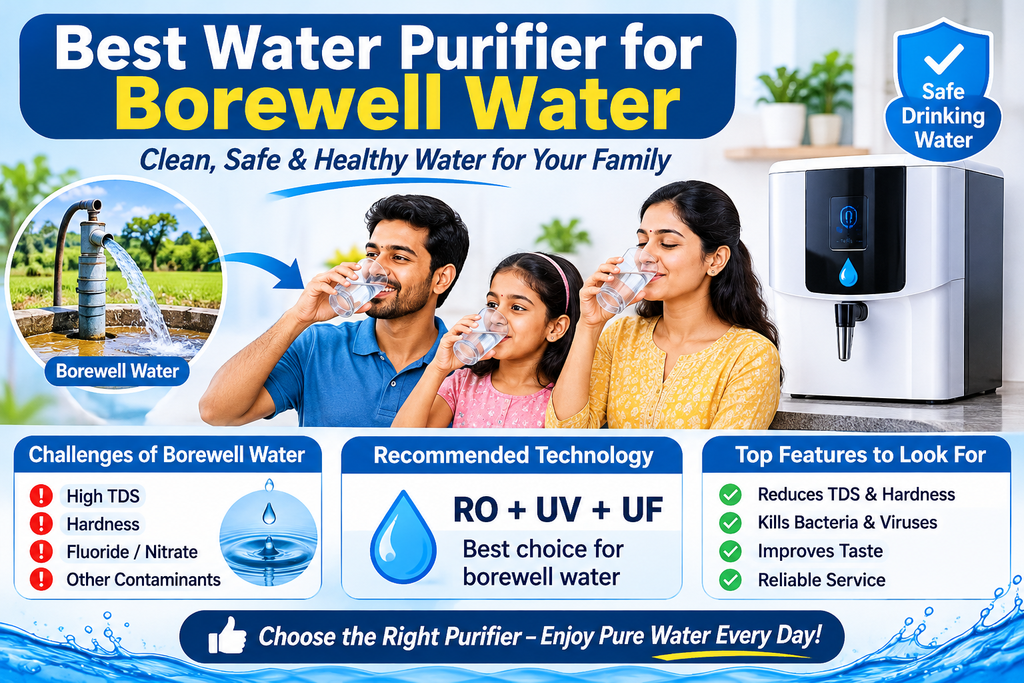
1. Why Does Borewell Water Need Special Attention?
Borewell water comes from underground sources. As groundwater moves through soil and rocks, it can dissolve minerals and other substances.
The quality depends on local geological and environmental conditions.
Some common borewell water problems include:
High TDS
TDS stands for Total Dissolved Solids. It indicates the concentration of dissolved substances such as salts and minerals in water.
High TDS may affect the taste of drinking water and can indicate the presence of excessive dissolved substances.
According to BIS drinking-water standard IS 10500, the acceptable TDS limit is 500 mg/L. The permissible limit is 2,000 mg/L when no alternative source is available.
Hard Water
Hard water contains higher concentrations of calcium and magnesium.
It may cause:
- White deposits on taps and bathroom fittings.
- Scale formation in heating appliances.
- Soap that does not lather easily.
- Scaling in water treatment equipment.
Iron
Some borewell sources contain excess iron.
Possible signs include reddish-brown stains, metallic taste and deposits. However, appearance alone cannot confirm the iron concentration.
Fluoride and Nitrate
Fluoride and nitrate can occur naturally or enter groundwater through human activities.
Excessive concentrations can create health concerns. These substances cannot be reliably identified by taste, smell or a TDS meter alone.
Microbial Contamination
Borewell water may become contaminated due to damaged borewell structures, nearby septic tanks, surface water entering the source or poor storage conditions.
Laboratory testing is important to identify these problems.
2. Which Water Purification Technology Is Best for Borewell Water?
The right technology depends on the contaminants present in your water.
RO (Reverse Osmosis)
RO is often a suitable option when borewell water contains high levels of dissolved salts or specific dissolved contaminants that the RO system is designed to reduce.
It uses a semipermeable membrane to separate water from many dissolved substances.
Benefits:
- Reduces TDS.
- Reduces many dissolved salts.
- Can reduce certain contaminants such as fluoride and nitrate, depending on system performance.
- Useful for certain high-TDS water sources.
Limitations:
- Produces reject water.
- Requires regular maintenance.
- May need pre-treatment if iron, hardness or suspended particles are high.
- Does not automatically remove every possible contaminant.
UV (Ultraviolet)
UV technology uses ultraviolet light to inactivate susceptible microorganisms.
It can provide an additional disinfection step when microbial contamination is a concern.
Benefits:
- Helps control bacteria and viruses when the system delivers an effective UV dose.
- Does not reduce TDS.
- Does not normally change the taste of water.
Limitations:
- Does not remove dissolved salts.
- Works best with clear, properly pre-treated water.
- Requires electricity and regular maintenance.
UF (Ultrafiltration)
UF uses a fine membrane to remove suspended particles and many microorganisms.
Benefits:
- Helps remove suspended particles.
- Can reduce many bacteria and parasites.
- Does not normally require electricity in gravity-fed systems.
- Does not produce RO-style reject water.
Limitations:
- Does not reduce TDS.
- Does not remove dissolved salts.
- Does not reliably remove all viruses.
3. RO vs UV vs UF for Borewell Water
| Feature | RO | UV | UF |
|---|---|---|---|
| Reduces TDS | Yes | No | No |
| Reduces dissolved salts | Yes | No | No |
| Reduces fluoride | Can, depending on system | No | No |
| Reduces nitrate | Can, depending on system | No | No |
| Controls bacteria | With suitable system | Yes, with effective UV dose | With suitable membrane |
| Controls viruses | With suitable system | Yes, with effective UV dose | Not reliably |
| Removes suspended particles | With prefilters | No | Yes |
| Produces reject water | Yes | No | Normally no |
For borewell water with high TDS, RO is often an important treatment option. UV or UF may be added when other water-quality concerns justify them.
4. Is RO+UV+UF the Best Combination for Borewell Water?
Many water purifier brands sell models with RO+UV+UF technology.
These systems combine different purification methods:
- RO: Reduces dissolved salts and certain chemical contaminants.
- UV: Inactivates susceptible microorganisms.
- UF: Filters suspended particles and many microorganisms.
Such a combination may be useful when your water has multiple treatment requirements.
However, every borewell does not need all three technologies.
For example:
- High TDS with dissolved contaminants: A suitable RO system may be needed.
- Microbial contamination: Effective disinfection, such as UV, may be required.
- Suspended particles: Appropriate sediment filtration or UF may help.
- High iron or hardness: Specialised pre-treatment may be necessary.
Important: Do not buy a purifier only because it advertises five, six or seven purification stages. Check whether those stages actually address your water-quality problems.
5. How to Choose the Best RO Water Purifier for Borewell Water?
Before purchasing an RO purifier, consider these important features.
1. TDS Reduction Performance
Check the purifier’s ability to reduce dissolved salts. Choose a model tested for the contaminants found in your water.
2. Pre-Filtration System
Borewell water may contain sand, mud, rust or other suspended particles.
A suitable sediment prefilter can protect the RO membrane and improve system performance.
3. Iron and Hardness Pre-Treatment
If your water contains excessive iron or hardness, an ordinary domestic RO purifier may not be enough.
Ask a qualified water-treatment professional whether iron removal, softening or another pre-treatment stage is required.
4. UV Protection
If water testing indicates microbial contamination, consider a purifier with a suitable disinfection system.
5. Storage Capacity
Choose a storage tank according to your family’s daily drinking-water requirements.
6. Filter and Membrane Replacement Cost
Before buying, compare:
- RO membrane replacement cost.
- Sediment filter cost.
- Carbon filter cost.
- UV lamp replacement cost, if applicable.
- Annual maintenance charges.
7. After-Sales Service
Choose a brand with reliable service availability in your area. Regular maintenance is especially important when the incoming water quality is poor.
6. How to Test Borewell Water Before Buying a Purifier?
This is one of the most important steps.
A simple TDS meter can provide a quick reading, but it cannot identify all contaminants.
For a better understanding of your water quality, get a laboratory test.
Consider testing for:
- TDS
- pH
- Total hardness
- Iron
- Fluoride
- Nitrate
- Chloride
- Arsenic, where relevant
- Turbidity
- Total coliform and E. coli
Compare the results with the applicable BIS drinking-water requirements.
You can also ask your local water-testing laboratory or government water-quality testing facility for guidance.
7. What Is the Ideal TDS Level for Borewell Drinking Water?
According to BIS IS 10500:
| TDS Level | BIS interpretation |
|---|---|
| Up to 500 mg/L | Acceptable limit |
| Above 500 up to 2,000 mg/L | Permissible only when no alternative source is available |
| Above 2,000 mg/L | Exceeds the stated permissible limit |
These figures refer to TDS only. Water must also meet the applicable limits for other chemical and microbiological parameters.
Do not assume that water is safe simply because its TDS is low.
8. Does Every Borewell Need an RO Water Purifier?
No.
Some borewell sources may have relatively low TDS but still contain other contaminants. Others may have high TDS or excessive hardness.
The right purification system depends on the actual water test results.
For example:
- If dissolved salts are high, RO may be appropriate.
- If dissolved salts are acceptable but microbial contamination is present, disinfection may be needed.
- If iron is high, specialised iron removal may be required.
- If hardness is high, a suitable softening or pre-treatment solution may be needed.
The best approach is to test first and choose the treatment afterwards.
Conclusion
Choosing the best water purifier for borewell water requires more than checking the brand, price or number of purification stages.
Borewell water quality can vary from one location to another. High TDS, hardness, iron, fluoride, nitrate and microbial contamination may require different treatment methods.
RO is often a useful choice for borewell water containing high dissolved salts, while UV, UF and specialised pre-treatment may be needed for other water-quality problems.
Before purchasing a purifier, get your borewell water tested and compare the purifier’s actual performance against the test results.
Remember: Test your water first, choose the right purification technology and maintain your purifier regularly.
Frequently Asked Questions (FAQs)
1. Which water purifier is best for borewell water?
A suitable RO purifier is often recommended when borewell water contains high TDS or dissolved contaminants that RO can reduce. The exact model and additional treatment stages should depend on laboratory test results.
2. Is RO+UV+UF good for borewell water?
It can be useful when the water requires dissolved-contaminant reduction, disinfection and membrane filtration. However, not every borewell needs all three technologies.
3. What TDS level is suitable for borewell drinking water?
The BIS acceptable TDS limit is 500 mg/L. The permissible limit is 2,000 mg/L when no alternative source is available. Other water-quality parameters must also meet the applicable standards.
4. Can an RO purifier remove hardness from borewell water?
RO can reduce dissolved calcium and magnesium, which contribute to hardness. Very hard water may require additional pre-treatment to protect the RO membrane.
5. Can an RO purifier remove iron?
Some RO systems can reduce certain forms of dissolved iron, but performance depends on the iron’s form and concentration. High iron may require specialised pre-treatment.
6. Is UV necessary with RO for borewell water?
Not always. UV may provide additional disinfection when microbial contamination is a concern. The requirement should be based on water testing and the design of the purifier.
7. How often should a borewell water purifier be serviced?
Service frequency depends on incoming water quality, daily usage and the manufacturer’s recommendations. Borewell water with high sediment or iron may require more frequent filter inspection.