
Choose your water purifier
Introduction
Choosing the right water purifier can be confusing, especially when you see terms like RO, UV and UF while shopping online.
All three technologies are designed to improve drinking water quality, but they work differently and remove different types of impurities.
For example, RO is useful for reducing dissolved salts, UV uses ultraviolet light to disinfect water, and UF uses a fine membrane to filter particles and microorganisms.
So, which one should you choose for your home?
In this guide, we will explain RO vs UV vs UF water purifiers, their working methods, advantages, disadvantages and the factors you should consider before buying one.
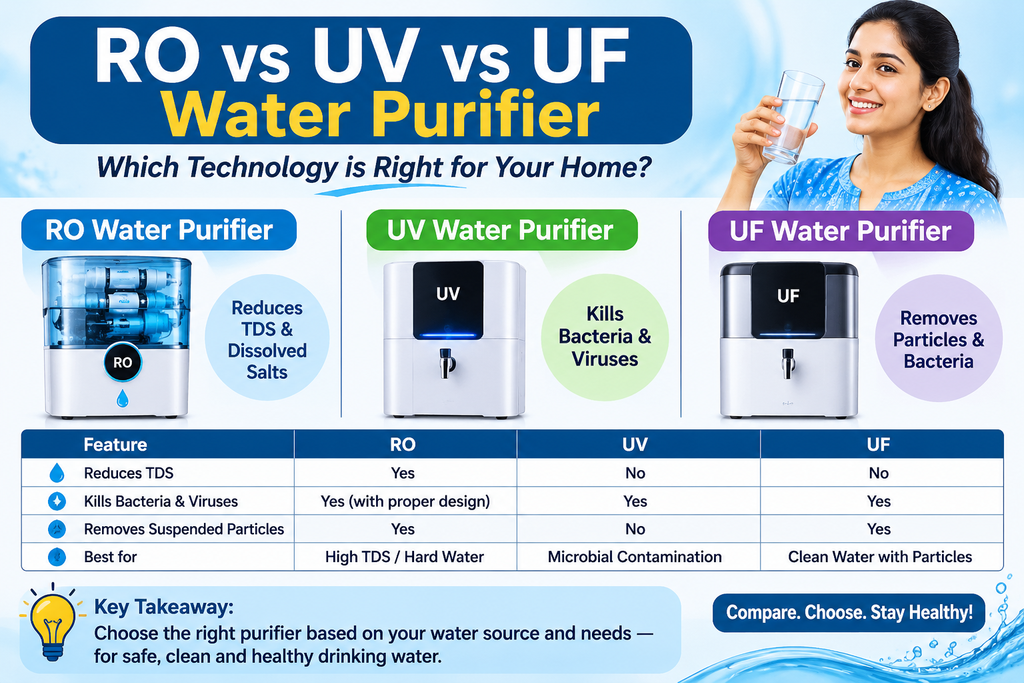
1. What Is an RO Water Purifier?
RO stands for Reverse Osmosis. It is a water purification technology that uses a special semipermeable membrane to reduce dissolved salts and other contaminants.
Water is pushed through the RO membrane under pressure. The membrane allows water to pass through while rejecting many dissolved substances.
RO systems can reduce substances such as:
- Excess dissolved salts
- Sodium and chloride
- Certain heavy metals
- Fluoride and nitrate, depending on the system
- Other dissolved contaminants specified by the manufacturer
Advantages of RO
- Reduces TDS and many dissolved impurities.
- Useful for certain high-TDS and saline water sources.
- Can reduce several chemical contaminants.
- Often combined with sediment, carbon and other filters.
Disadvantages of RO
- Requires electricity and sufficient water pressure.
- Produces reject water during purification.
- Requires regular membrane and filter maintenance.
- Removes some naturally occurring minerals along with unwanted dissolved substances.
Best suited for: Water containing high levels of dissolved salts or other contaminants that the particular RO system is designed to reduce.
2. What Is a UV Water Purifier?
UV stands for Ultraviolet. This technology uses ultraviolet light to disinfect water.
When water passes through a UV chamber, the light damages the genetic material of susceptible microorganisms, preventing them from reproducing and causing infection.
UV treatment is designed to control microorganisms such as:
- Bacteria
- Viruses
- Certain parasites, when the system provides an effective treatment dose
However, UV does not physically remove these microorganisms from water. It inactivates them.
Advantages of UV
- Disinfects water without adding chemicals.
- Does not significantly change the taste of water.
- Does not reduce TDS.
- Usually requires less water than an RO system because it does not produce RO reject water.
Disadvantages of UV
- Does not remove dissolved salts or heavy metals.
- Does not remove chemical contaminants.
- Works best when water is clear and properly pre-filtered.
- The UV lamp and system need regular maintenance.
Best suited for: Water with acceptable chemical quality and TDS but a risk of microbial contamination.
3. What Is a UF Water Purifier?
UF stands for Ultrafiltration. It uses a membrane with very small pores to physically filter suspended particles and many microorganisms.
Water passes through the membrane, while particles larger than its effective pore size are retained.
UF technology can help remove:
- Suspended particles
- Sediment and some dirt
- Many bacteria
- Certain parasites
Its effectiveness against viruses varies by membrane and system design. Do not assume that every UF purifier removes viruses.
Advantages of UF
- Does not require electricity in many gravity-fed models.
- Does not normally produce reject water.
- Retains most dissolved minerals.
- Helps remove suspended particles and many microorganisms.
Disadvantages of UF
- Does not reduce TDS.
- Does not remove dissolved salts.
- Does not reliably remove all viruses.
- Requires cleaning or replacement according to the manufacturer’s instructions.
Best suited for: Water with low dissolved solids but suspended particles or microbial concerns that the particular UF system can address.
4. RO vs UV vs UF: Main Differences
Here is a simple comparison to help you understand the three technologies.
| Feature | RO | UV | UF |
|---|---|---|---|
| Full form | Reverse Osmosis | Ultraviolet | Ultrafiltration |
| Working method | Membrane separation | UV light disinfection | Membrane filtration |
| Reduces TDS | Yes | No | No |
| Reduces dissolved salts | Yes | No | No |
| Controls bacteria | Yes, with a suitable system | Yes, with an effective UV dose | Yes, with a suitable membrane |
| Controls viruses | Yes, with a suitable system | Yes, with an effective UV dose | Not reliably in all systems |
| Removes suspended particles | With suitable prefilters | No, needs prefiltration | Yes |
| Electricity | Usually required | Required | Not always required |
| Reject water | Yes | No | Normally no |
Important: Actual performance depends on the purifier’s design, certification, membrane quality, maintenance and the contaminants present in your water. Always check the manufacturer’s performance claims.
5. RO vs UV vs UF: Which Is Best for Indian Homes?
There is no single best technology for every Indian household. Your choice should depend on your water source and its actual quality.
If your home uses borewell water
Borewell water may contain high dissolved salts, hardness, fluoride, iron or other contaminants depending on the location.
An RO system may be appropriate when testing confirms high TDS or dissolved contaminants that RO can reduce. Additional treatment may be needed for specific contaminants.
If your home uses municipal water
Municipal water is generally treated before distribution, but its quality can vary due to storage tanks and distribution pipelines.
If dissolved salts are within acceptable limits, a suitable UV or UF system with appropriate prefiltration may be sufficient, depending on the contamination risk.
If your home uses tanker water
Tanker water quality can vary significantly because the source and handling conditions may differ.
Get the water tested before choosing a purifier. A combination of technologies may be required depending on the results.
6. What Is an RO+UV+UF Water Purifier?
Some modern water purifiers combine two or more purification technologies.
For example:
- RO + UV: RO reduces dissolved salts and certain chemicals, while UV provides an additional disinfection step.
- RO + UV + UF: Combines dissolved-contaminant reduction, UV disinfection and membrane filtration.
- UV + UF: Combines disinfection and physical filtration without reducing TDS.
A combination purifier can be useful when the water contains different types of contaminants. However, more technologies do not automatically mean better water.
Choose a model based on your water test results rather than buying a purifier simply because it has the most features.
7. How to Choose the Right Water Purifier?
Before purchasing a water purifier, consider these important points:
- Check your water source: Identify whether your home receives borewell, municipal or tanker water.
- Test water quality: Check TDS and other relevant chemical and microbiological parameters.
- Choose suitable technology: Select RO, UV, UF or a combination according to the contaminants found.
- Compare maintenance costs: Check the price and replacement frequency of filters, membranes and UV lamps.
- Check storage capacity: Choose a tank capacity suitable for your family’s daily requirements.
- Check service availability: Make sure spare parts and authorised service are available in your area.
- Verify product claims: Look for reliable testing and certification relevant to the contaminants you want to reduce.
Conclusion
RO, UV and UF are three different water purification technologies, and each has its own purpose.
- RO is useful for reducing dissolved salts and certain chemical contaminants.
- UV disinfects water by inactivating susceptible microorganisms.
- UF filters suspended particles and many microorganisms through a fine membrane.
The right choice depends on your water quality, not simply the brand or price of the purifier.
Before buying, get your drinking water tested and select a purifier designed to address the contaminants found in it.
Remember: The best water purifier is not necessarily the one with the most purification technologies. It is the one that provides suitable treatment for your home’s water quality.
Frequently Asked Questions (FAQs)
1. Which is better, RO or UV water purifier?
Neither is universally better. RO reduces dissolved salts and certain chemicals, while UV disinfects water. Choose according to your water test results.
2. Does a UF water purifier reduce TDS?
No. UF filters suspended particles and many microorganisms but does not remove dissolved salts, so it does not significantly reduce TDS.
3. Can UV purifier remove bacteria and viruses?
An appropriately designed and maintained UV system can inactivate bacteria and viruses when it delivers the required UV dose. It does not physically remove them.
4. Is RO+UV+UF better than RO alone?
It can provide multiple treatment steps, but it is not automatically necessary. The additional technologies should address actual water-quality concerns.
5. Which water purifier is best for borewell water?
RO may be suitable when borewell water contains high TDS or dissolved contaminants that RO can reduce. Test the water before making a decision.
6. Does RO water waste water?
Yes. RO systems produce reject water during purification. The quantity varies by system design and operating conditions.
7. Do I need an RO purifier for municipal water?
Not always. If municipal water has suitable chemical quality and no relevant dissolved-contaminant problem, a UV or UF-based system may be sufficient depending on microbial risks.